
Criminal Cases in Charlotte County Courts
Charlotte County divides trial-level criminal work between two courts at the Charlotte County Justice Center. The Twentieth Judicial Circuit Court hears felonies. Charlotte County Court hears misdemeanors, criminal traffic, and county or municipal ordinance matters. Punta Gorda does not keep a separate municipal criminal court, so an ordinance case still routes through the county Clerk. That distinction matters when selecting a court type in an online search.
The Charlotte County Clerk Criminal Division keeps both sets of case files. A citation may state the court date, time, and place. Bond-release papers may do the same. If neither is at hand, a name or case-number search can locate the docket. The Clerk's file records prosecution and outcome; an arrest report remains with the arresting agency.
Felony and Misdemeanor Court Routes
A felony accusation moves in Circuit Court, while a misdemeanor or criminal traffic charge ordinarily stays in County Court. The prosecutor's formal information may narrow, replace, or decline an officer's booking allegations. For that reason, the charge in a jail screen should never substitute for the filed Charlotte County court charge.
The State Attorney's Charlotte office reviews arrests for legal sufficiency from the same Justice Center complex. The office is at 350 E. Marion Avenue and can be reached at 941-637-2104, but it does not accept criminal complaints by email. This prosecutorial review is one reason an early arrest label and a later case caption may differ.
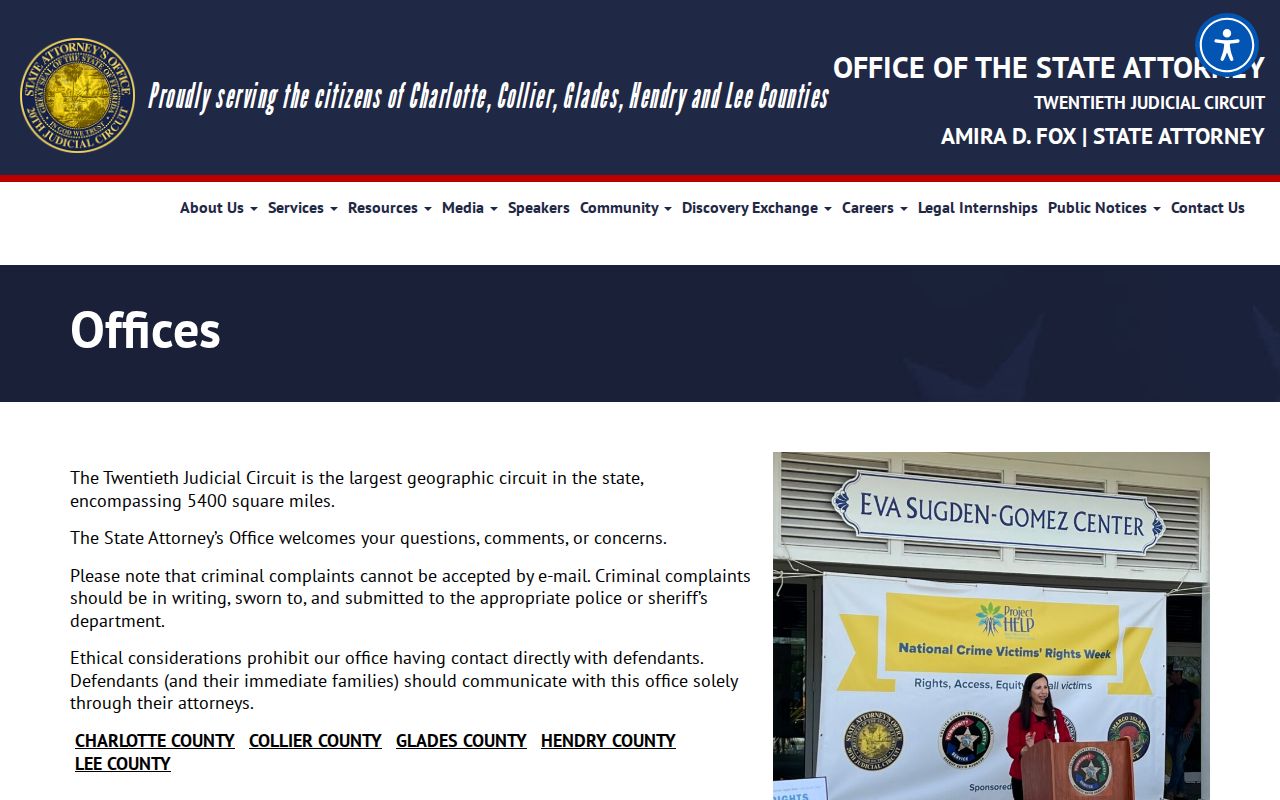
The official office view helps identify the prosecutor's role without confusing that office with the Clerk, which remains custodian of the court file.
How to Search Case Records
The free Charlotte Clerk Benchmark Case Search accepts a party name, case number, or citation number. Names use the format Last, First. Optional opened and closed date ranges and court-type filters help separate people with similar names. Search results are informational; obtain the official document when the exact text or legal effect matters.
- Open Benchmark and select All, Name, Case Number, or Citation Number.
- Enter the name as Last, First, or use the exact case or citation identifier.
- Narrow the result with opened or closed dates and FELONY, MISDEMEANOR, TRAFFIC, or ordinance filters.
- Open the matching docket and compare parties, dates, status, hearings, events, charges, and disposition.
- Order an eCertified copy or contact Court Services when an official or archived document is needed.
| Field Label | Type | Required | Notes |
|---|---|---|---|
| Search mode | Choice | Yes | All, Name, Case Number, or Citation Number |
| Name | Text | Conditional | Use Last, First |
| Case or citation number | Text | Conditional | Illustrated case format is YY######F |
| Opened / Closed dates | Date | No | Narrows the filing or closing window |
| Court Types | Multi-select | No | Choose felony, misdemeanor, traffic, or ordinance categories |
When Charlotte Name Results Multiply
A broad name query may return several Charlotte County cases or people. Compare the full party name, filing dates, court type, and case status before opening a docket. Add an opened-date range if the event year is known. A case number is stronger than a name because it points to one file, but even then the reader should confirm the court and party.
The official Benchmark screen shows the controls that can reduce false matches.
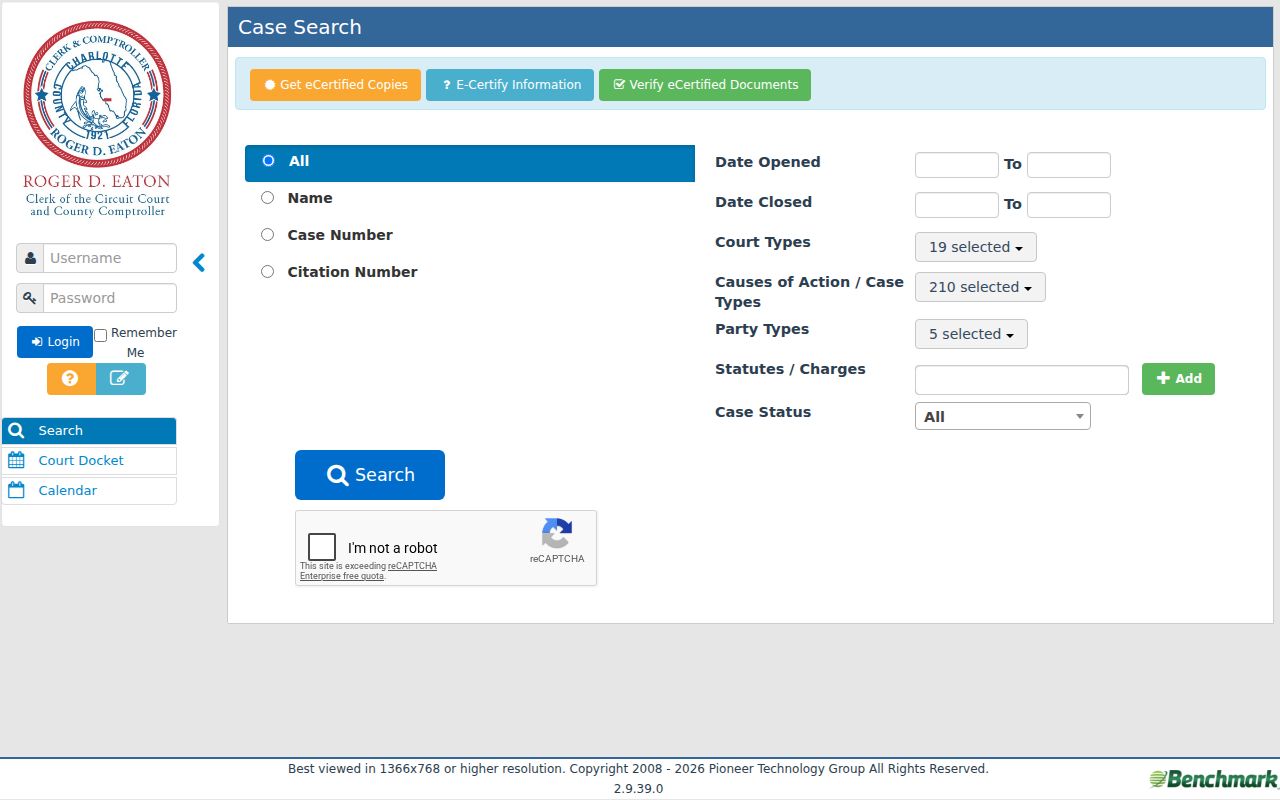
Those filters help locate a likely docket; they do not turn the online display into a certified Charlotte County court record.
What the Case File Shows
A Charlotte County criminal case file can show the filed accusation, each count, counsel and judge, docket events, hearing notices, pleas, motions, bond activity, disposition, sentence, and later enforcement. Read each count because one case can hold several outcomes. A closed label alone does not say whether a count ended in conviction, dismissal, nolle prosequi, or acquittal.
| Case Number & Court | Identifies the Charlotte County file, division, and court level. |
|---|---|
| Charging Document | The information, indictment, or complaint states charges formally pursued. |
| Docket Entries | A dated event history may include filings, motions, notices, and capias entries. |
| Hearing Dates | Calendars and notices identify scheduled court events and appearances. |
| Disposition & Judgment | Shows the result by count, including guilt, dismissal, acquittal, or other outcome. |
| Sentence & Conditions | Records incarceration, probation, financial assessments, and lawful conditions. |
Online Docket or Official Copy
Benchmark is the fast index. The Clerk's filed document is the controlling record. Download links vary by file, and protected material will not appear merely because the case number is public. Use the Clerk-linked eCertification service or the counter for a certified copy. Court Services can also route an archived request through 941-505-4716 or clerkinfo@charlotteclerk.com.
For an in-person request, the Charlotte County Justice Center information identifies the courthouse at 350 E. Marion Avenue, visitor hours, parking, and security rules.
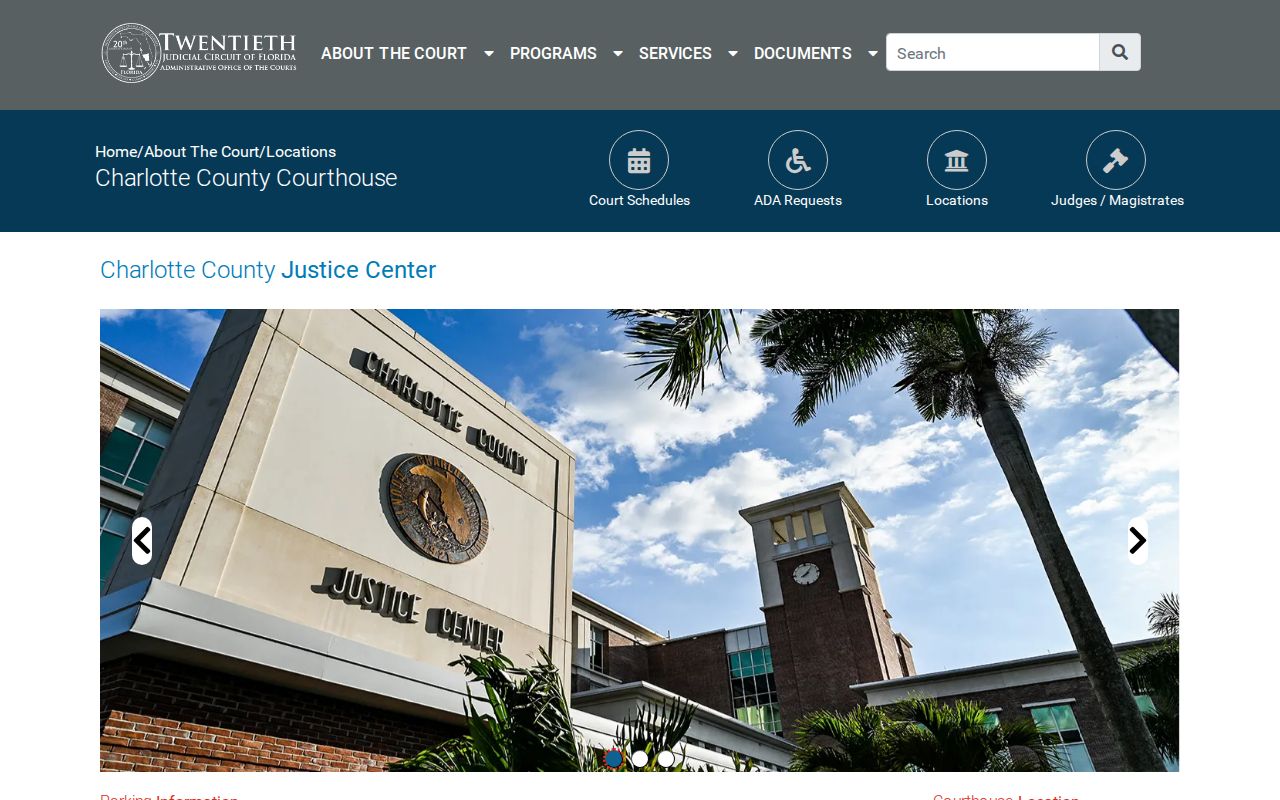
The building houses the Clerk, courts, State Attorney, Public Defender, and Pretrial Services, but each office performs a different records role.
Stages of a Criminal Case
After an arrest and first appearance, the State Attorney may file an information, a grand jury may return an indictment, or no formal charge may follow. Arraignment addresses the charge and plea. Discovery, motions, and pretrial hearings come next. A negotiated plea or trial can lead to adjudication and sentence, followed by enforcement or appeal. Charlotte County's jail video courtroom supports first appearances, arraignments, and bond hearings, so early docket events may occur without courthouse transport.
Case flow: Charges Filed › Arraignment › Pretrial › Plea or Trial › Disposition › Sentencing
Charlotte Pretrial Services
Pretrial Services occupies the Justice Center's first floor and operates weekdays from 8 a.m. to 4:30 p.m. at 941-637-2116. Its role concerns court-ordered pretrial reporting and supervision, not the custody of the docket. The Clerk remains the source for filed orders and case status.
The official Charlotte Pretrial Services page publishes its local office information and forms.
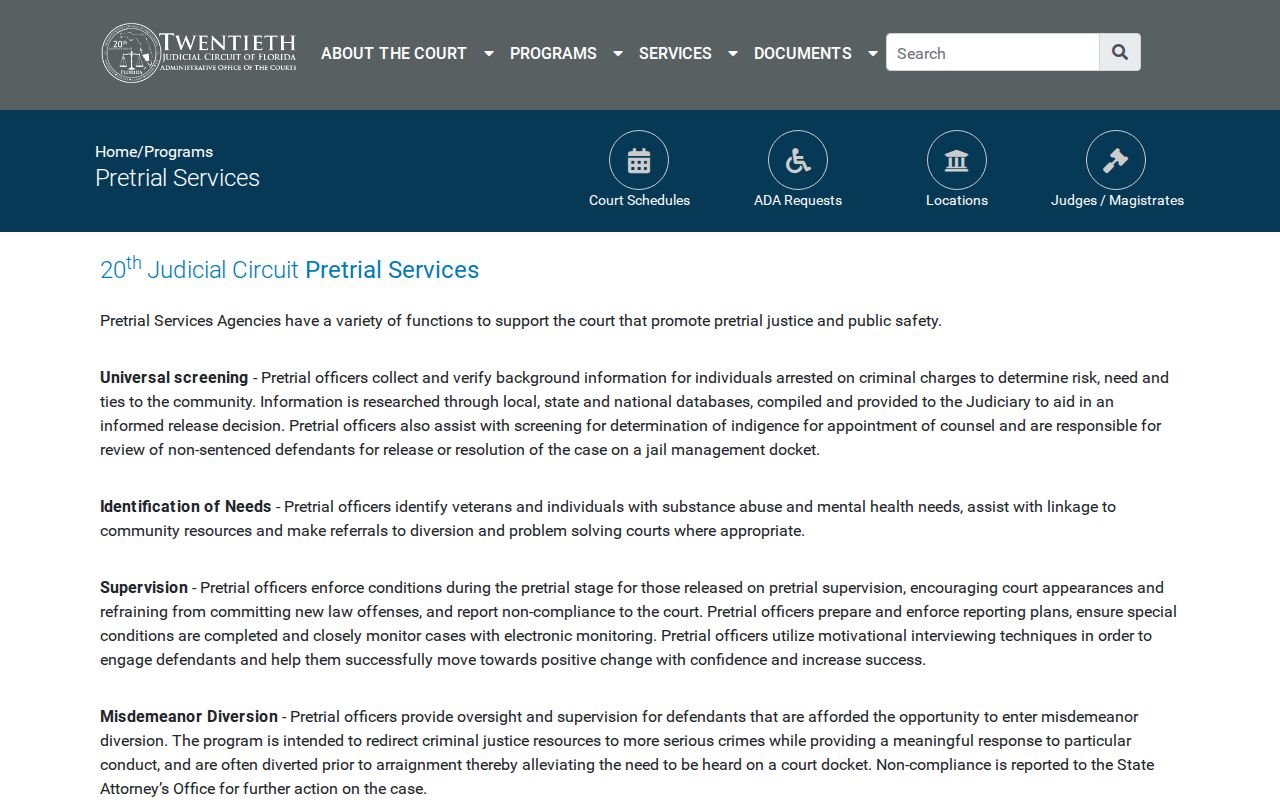
When reporting terms and a public docket seem inconsistent, the signed Charlotte County court order should guide the next confirmation call.
Reading Charlotte Disposition Terms
Adjudicated guilty is a conviction. Adjudication withheld is not an acquittal and can still carry consequences. Nolle prosequi means the prosecutor ended a charge, while no information filed means no formal charge was filed. A dismissal ends the charge in court; an acquittal follows a not-guilty result.
None of those nonconviction labels automatically deletes the arrest event from a Florida history. Compare the final Charlotte County disposition with FDLE data when reviewing one's own record. If a capias appears, confirm whether it is current with the Clerk or counsel because a historical docket event is not a live-status guarantee.
When a Charlotte Court Date Is Missed
Missing a required Charlotte County appearance can create both a court problem and a driver's-license problem. The criminal docket may show a warrant or capias event, while the state may suspend driving privileges. Do not assume an old event remains active, and do not assume that a blank public screen provides clearance. Use the exact case number to confirm the filed status with the Clerk or counsel.
If the event has been recalled, quashed, or otherwise resolved, keep the signed order or receipt and allow time for linked systems to update. Benchmark may preserve the historical entry even after the current status changes. Court staff can identify the public filing and next scheduled event, but they cannot advise a person how to surrender, post bond, or defend the charge.
Access and Restrictions
Florida Public Records Law generally supports inspection, but court records contain targeted exemptions. Section 119.0714 protects specified personal data in court files. Juvenile material, sealed content, confidential victim information, Social Security and account numbers, and other protected data may be withheld or redacted. An online omission therefore does not prove that no Charlotte County case exists.
Ask the Clerk about an exact case number when a public screen lacks a document. Staff can explain access and copy channels but cannot give legal advice. A sealed case will not become public through a broader name search, and an active investigative exemption at an agency is separate from access to a filed court document.