
Running a Sex Offender Check in Charlotte County
The Florida Sexual Offenders and Predators Search, maintained by the Florida Department of Law Enforcement, is the controlling public source for Charlotte County sex offender records. FDLE compiles reports supplied by registrants, law enforcement, the Florida Department of Corrections, and the Department of Highway Safety and Motor Vehicles. FDLE cautions that it does not independently confirm every submitted fact. That limit makes identity matching vital. Compare the photograph, aliases, physical description, address type, birth information, vehicle details, and qualifying offense before drawing a conclusion.
The state portal is the main access channel. Local law enforcement supplies registration and compliance information, and suspected noncompliance may be reported to the agency serving the address. FDLE also takes corrections and compliance reports at 1-888-357-7332 or sexpred@fdle.state.fl.us. For records beyond Florida, use the federal national search. Do not treat an empty result as proof that no registration exists. Recheck spelling, partial names, nearby ZIP codes, and prior jurisdictions.
The official FDLE search page shows how Florida presents its public name and neighborhood tools.
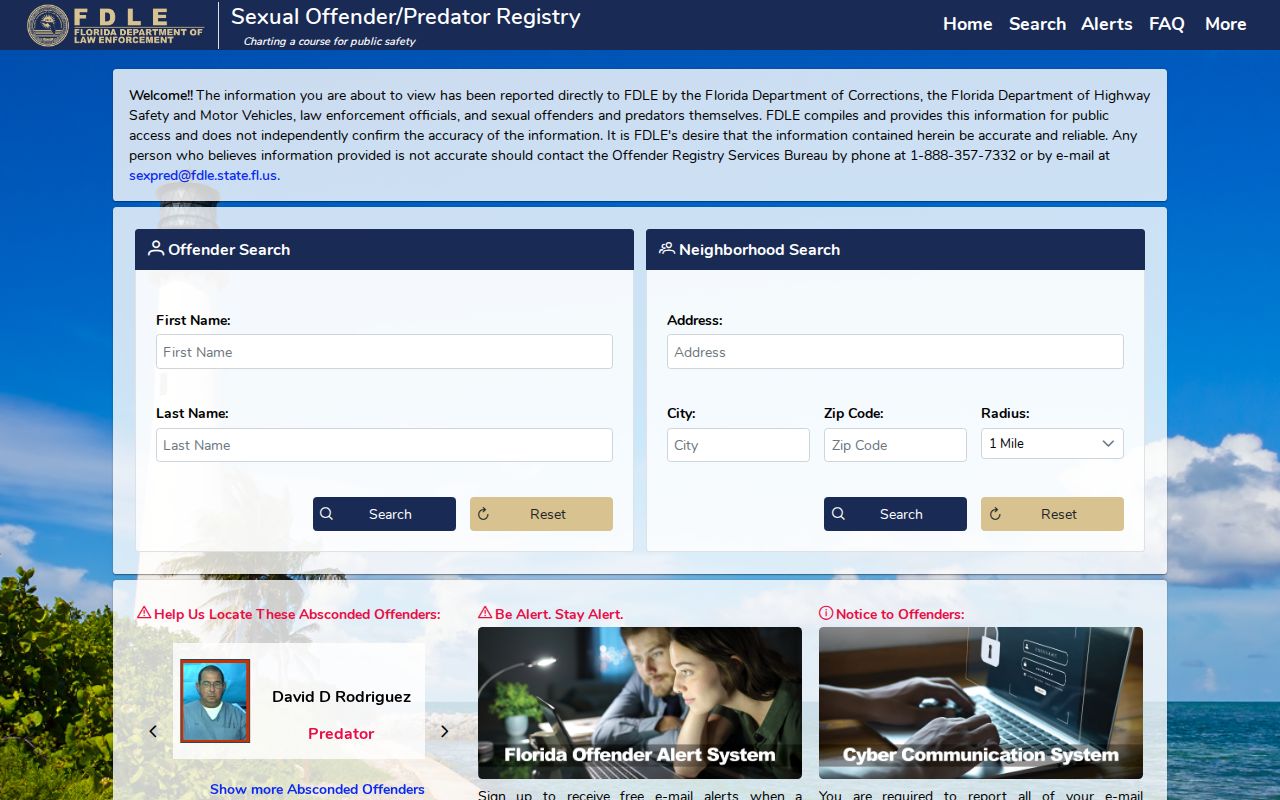
This statewide interface is the proper first stop for a Charlotte County registry lookup.
Charlotte County Registry Designations
Florida does not use a simple public Tier I, Tier II, and Tier III chart. Its law uses the designations sexual offender and sexual predator, tied to state statutes and offense-specific rules. The difference matters because the label, registration duration, and reporting schedule cannot be translated into a generic federal tier without losing accuracy. A registry profile is also narrower than a Charlotte County court file. It identifies the registration basis and current reporting data, but it does not reproduce every motion, plea, order, or later docket event.
Status labels describe a reporting or custody condition. Public labels can include Absconded, Civil Commitment, Confinement, Deceased, Deported, Released Subject to Registration, Supervised by FDC, Supervised by DJJ, and Supervised by U.S. Probation. None is a standalone risk score. “Absconded,” for example, signals a compliance concern that belongs with law enforcement, not a request for private action.
Searching the Florida Sexual Offenders and Predators Search
Start broad enough to catch spelling variations, then narrow the results with location and identifying details. The basic search accepts full or partial names. Neighborhood search uses an address with city, ZIP code, and radius controls. The extended search can use name, city, county, or ZIP, with at least one criterion supplied.
- Open the FDLE registry and review its conditions of use.
- Choose a name search, neighborhood search, or extended search.
- Enter a partial or full name, or use Charlotte County place fields.
- Open likely profiles and compare several identifiers before relying on a match.
| Search | Field or Control | Required | Use |
|---|---|---|---|
| Basic | First and last name | No | Full or partial names accepted |
| Neighborhood | Address, city, ZIP, radius | Conditional | Finds records around a place |
| Extended | Name, city, county, ZIP | One criterion | Narrows a Charlotte County search |
| Results | Select checkboxes | No | PDF printing is limited to 25 selected records |
| Actions | Search, Reset, CSV | As needed | Runs, clears, or downloads public data |
The official extended-search screen illustrates the added place filters available to a Charlotte County searcher.
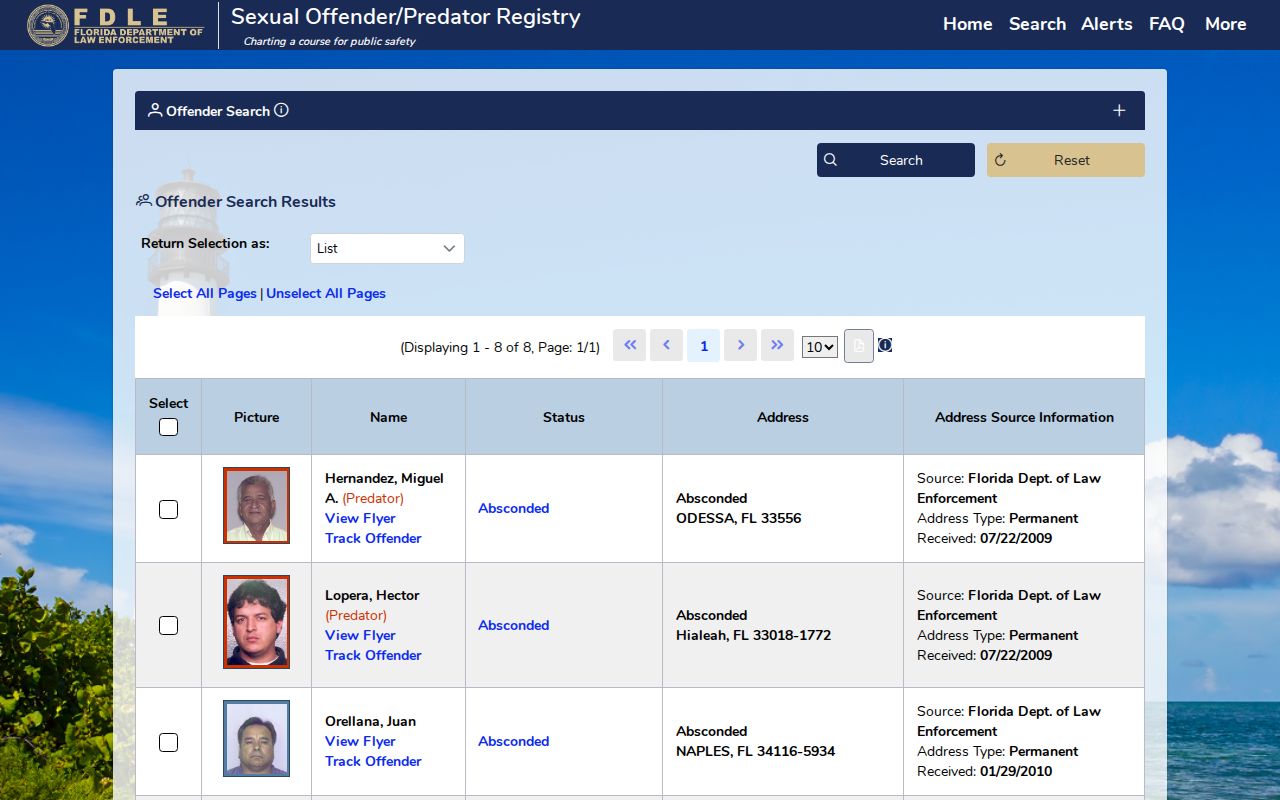
Those filters help separate similar names without exposing or republishing private details here.
Punta Gorda Registry Monitoring
Punta Gorda adds a distinctive city layer to the Charlotte County sex offender system. The Punta Gorda Police Department has operated a Sexual Offender Monitoring Program since April 2005. Officers check FDLE data daily for new city registrants, verify residences, review criminal history, case information, and supervision conditions, and assess nearby schools, day-care sites, and other at-risk places. The program then supports notification and coordination with probation or parole.
An assigned officer makes documented personal contact at least monthly. Program questions go to Captain Norm Nahra at 941-575-5533. This work does not replace FDLE's registry. It is a local verification and notification layer for addresses within Punta Gorda. Elsewhere in Charlotte County, contact the law-enforcement agency that serves the location when reporting suspected noncompliance.
What a Charlotte Registry Profile Shows
A public profile joins identifying, offense, address, vehicle, and status fields. Read the whole record instead of relying on the name alone. Florida also collects some identifiers that do not all appear publicly, so the visible page is not a complete agency file.
| Name and Aliases | Reported names and alternate identities used to distinguish records. |
|---|---|
| Photo and Description | Photograph, age or birth data, physical traits, scars, marks, and tattoos where public. |
| Registered Address | Permanent, temporary, or transient residence information reported to authorities. |
| Offense Details | Qualifying offense, statute, adjudication, and jurisdiction. |
| Designation | Florida sexual offender or sexual predator classification, not a generic tier. |
| Status | Supervision, confinement, release, compliance, or absconded information. |
| Other Fields | Vehicles, higher-education data, and public internet identifiers when applicable. |
The profile supports identity checks and safety planning. It does not show the whole Charlotte County criminal court docket, prove current conduct, or predict future behavior.
Charlotte Searches Across State Lines
Use the National Sex Offender Public Website when a person, former address, school, or work history spans more than Florida. NSOPW is a U.S. Department of Justice search across participating jurisdictions. It is a second layer, not a substitute for reviewing the Florida source record and the notices attached to that record.
The national search page demonstrates why a cross-state check can add value after an FDLE lookup.
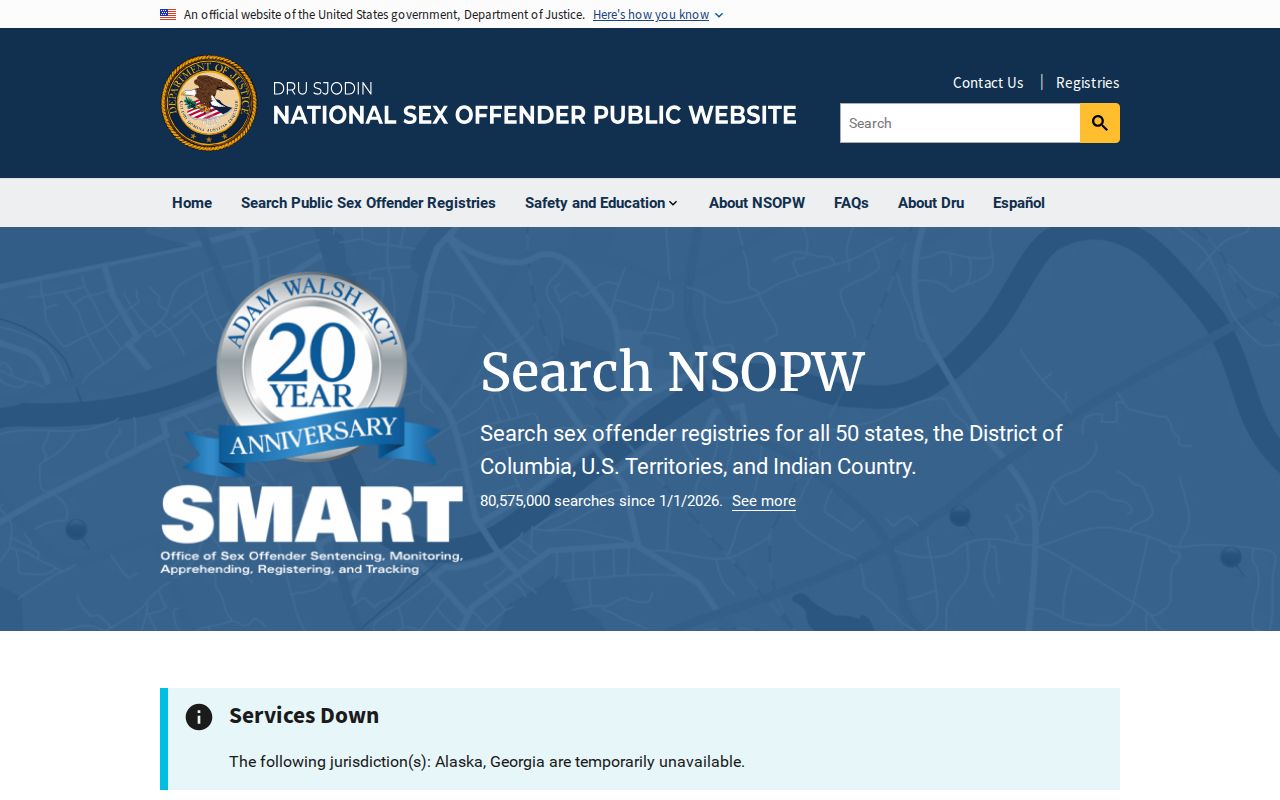
Return to FDLE for the Florida profile details and to local law enforcement for a Charlotte County compliance concern.
Registration Requirements and Levels in Florida
Florida registration is generally long term and often lifelong. Reporting frequency depends on the designation and qualifying category. Changes and travel rules can trigger action within 48 hours, so a twice-yearly schedule does not mean every update waits for the next regular report.
| Florida Category | General Duration | Reporting Pattern |
|---|---|---|
| Sexual predator under §775.21 | Lifetime | Quarterly for predators |
| Sexual offender under §943.0435 | Generally lifetime | Generally twice yearly unless a higher-frequency category applies |
| Specified higher-frequency categories | Based on governing designation | Birth month and every third month |
| Qualifying petition case | Possible relief after at least 25 arrest-free years following lawful release | Serious exclusions and court review apply |
Florida's limited petition route is not automatic removal. Qualification depends on the statute, elapsed time after release from confinement or supervision, an arrest-free period, and exclusions for serious offenses. Failure to register is generally a third-degree felony.
The FDLE registry FAQ supplies the official explanations for designation, duration, and reporting.
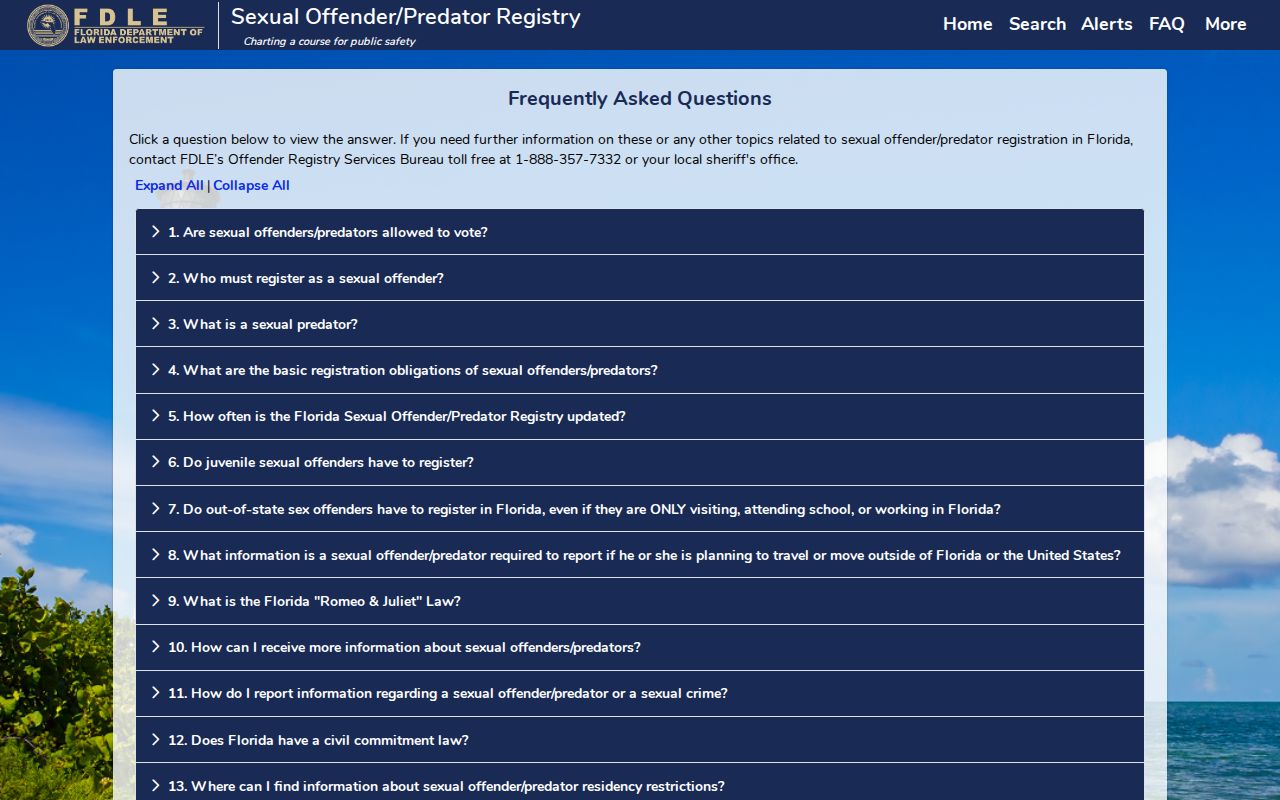
Its guidance is the sound reference when a profile label or reporting schedule is unclear.
Correcting Charlotte Registry Information
FDLE receives the data but warns that it does not independently verify every entry. If a public field appears wrong, note the precise profile and field rather than circulating the disputed information. Corrections may be reported to FDLE at 1-888-357-7332 or sexpred@fdle.state.fl.us. Local law enforcement is the right channel for suspected failure to register or an address-compliance concern.
Keep screenshots, dates, and reference numbers from any report. Do not confront a listed person or household. An agency can compare the public display with its source data, registration contact, and supervision information. A registry correction is different from challenging a criminal-history record or changing a court case. Each product has its own custodian.
Separate an identity problem from a status question. A misspelled alias, outdated vehicle, or disputed physical detail concerns the registry profile. A missing court disposition belongs with the Charlotte County Clerk or the court that entered the order. An error in one's broader Florida fingerprint-linked history belongs in FDLE's Personal Review and challenge process. Sending the issue to the right custodian avoids a circular referral and preserves a clear paper trail.
Give the agency enough detail to find the entry without sending private data to unrelated people. Identify the public profile, state what appears inaccurate, cite the official source that supports the correction, and retain the response. If the concern is urgent suspected noncompliance, call local law enforcement or FDLE instead of waiting for an ordinary records correction.
Lawful Use and Community Notification
Registry access supports personal, family, and community safety. Punta Gorda's program may conduct neighborhood notification after its address and location assessment. The public can also provide suspected noncompliance information to local law enforcement or FDLE. Those channels keep verification with trained officials and preserve an accurate record of the concern.
Use Registry Data Lawfully: Florida's FDLE legal notice forbids misuse, material alteration, and false distribution. Never use registry information to harass, threaten, intimidate, or engage in vigilantism.
A listing is not permission to contact, follow, publish private details about, or punish a person or household. Check the official record, account for its limits, and let law enforcement address compliance. Community awareness works best when facts remain tied to the official source.