
How to Check Criminal History in Punta Gorda
Begin with the office that created the record. Punta Gorda Police holds city incident and arrest narratives. Charlotte County Sheriff's Office holds booking and custody records for everyone PGPD arrests. The Charlotte County Clerk holds the prosecution docket, court documents, disposition, and sentence. FDLE's Computerized Criminal History Internet product covers reported Florida fingerprint-linked events, but it does not replace a local case file.
- Ask PGPD Records for the city incident or arrest report.
- Use the PGPD GovQA portal, telephone, or records counter as the request channel.
- Check Charlotte County Jail when the event involved an arrest and booking.
- Search the Charlotte Clerk Benchmark system for filed charges and disposition.
- Use FDLE for the statewide reported history or a fingerprint personal review of your own record.
Keep names, dates, report numbers, citation numbers, and case numbers as you move between systems. A very recent booking may appear before a prosecutor files a case. A city report may also exist without an arrest, while a citation can create a county court matter without a jail booking.
Punta Gorda Reports and Court Files
A PGPD report and a Charlotte County court file answer different questions. The city report explains the event as documented by the responding or investigating officer. It may include the location, date, involved people, narrative, evidence references, and an arrest affidavit. The clerk file shows what prosecutors actually filed and how the court handled it. Booking allegations can change, be reduced, or never become formal charges.
This division prevents a common search error. Do not use the police request portal to look for a final disposition. Likewise, do not expect the court docket to reproduce every fact in an incident narrative. When the outcome matters, compare the city report with the clerk's official documents. The broader Charlotte County criminal court case records explain the docket fields and certified-copy route in more depth.
The Punta Gorda Police Department
PGPD is a full-service city agency with 49 sworn members, 21 professional staff, three reserve officers, and more than 65 volunteers. Its units include Patrol, Criminal Investigations, Community Services, Marine Patrol, K-9, Communications, Records, and Volunteers in Policing. The marine and canal setting gives local enforcement a shape unlike an inland department, yet records still route through the same city Records function.
The Public Safety Building is at 1410 Tamiami Trail, Punta Gorda, FL 33950. The main and nonemergency number is 941-639-4111. Records custodian Supervisor Eric Burris can be reached at 941-575-5508, and Records is open weekdays from 8 a.m. to 4:30 p.m. Evidence and property questions go to 941-575-5544 by appointment. PGPD does not provide fingerprinting, so a person who needs prints must use another authorized channel.
Requests may be made at the counter, by phone, or online. Describe the date, place, report number if known, involved names, and exact record sought. Asking for an incident report is more precise than asking for every possible criminal record.
Punta Gorda GovQA Requests
The city-designated PGPD GovQA records portal offers separate entry choices for City Records Request and Police Department Records Request. It also provides My Records Center, Public Records Archive, and a Knowledge Base. Select the police route for an incident, arrest narrative, or other PGPD record. The city route covers non-police municipal material.
The portal screenshot shows the session choices and records-request interface used by Punta Gorda.
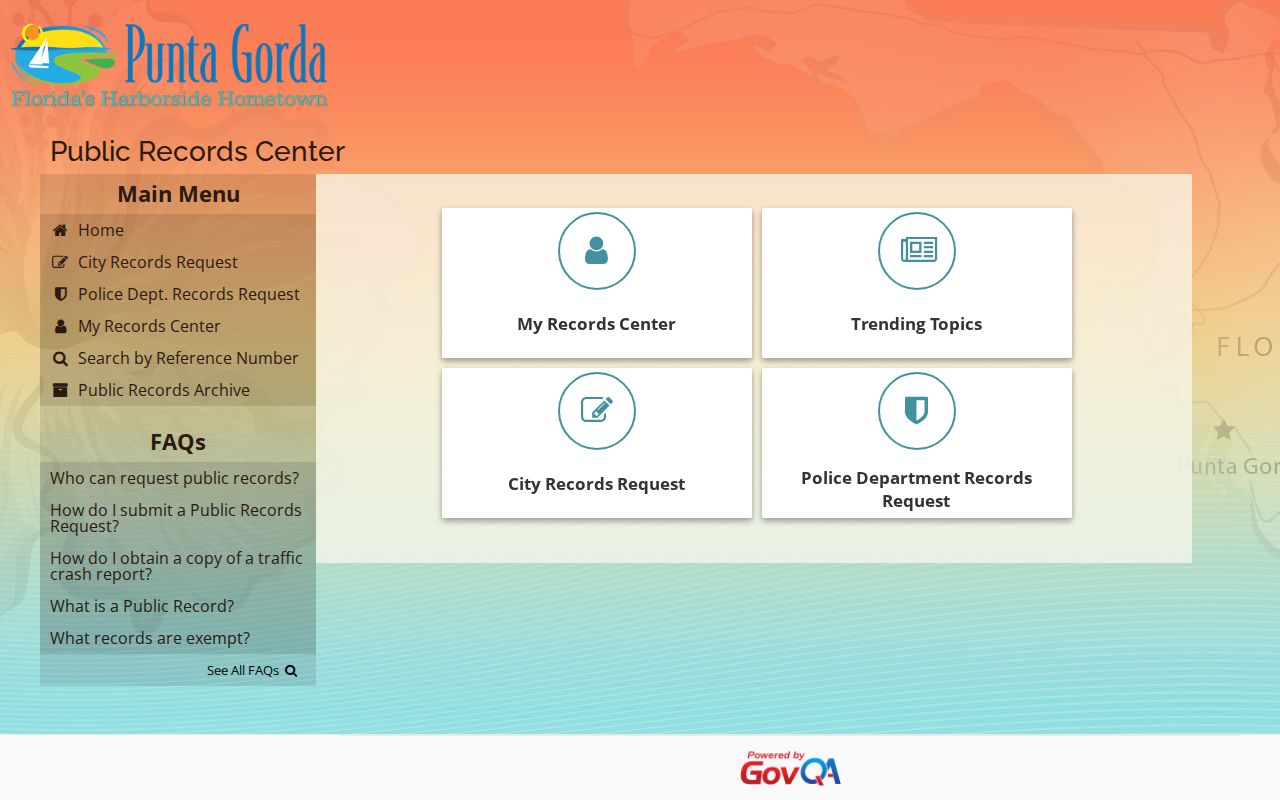
This portal supplements the records counter and phone channel rather than replacing them.
A returning user signs in with an email address and password, with a 50-character maximum shown for the password field. Creating an account enables ordinary tracking and email communication. An anonymous request is allowed, but it cannot receive updates or be tracked in the usual way. Save the assigned reference number immediately. An illustrated format is P002553-093015, though each real request receives its own number. The research did not verify hidden detail fields beyond the session gate, so requesters should follow the live prompts.
Arrests and Bookings in Punta Gorda
PGPD has no separate public city holding roster. Everyone the department arrests is transported to Charlotte County Jail. That means a Punta Gorda arrest creates at least two potential record paths: PGPD owns the incident and arrest narrative, while CCSO jail owns intake, booking, custody, and release data. The jail is at 26601 Airport Road in the Punta Gorda area, and its main number is 941-833-6300.
Use the official CCSO booking system for a recent custody check. If an older record is absent or the live portal is unavailable, request the booking material through CCSO's public-records channel. The filing stage comes next. A prosecutor may choose charges that differ from the initial booking allegations, so the clerk docket is the place to confirm the case and outcome. An arrest or booking proves that the event occurred, not guilt.
After a Punta Gorda Arrest
The record changes hands in stages. PGPD documents the encounter. CCSO accepts the person into the county jail and creates custody data. The State Attorney reviews legal sufficiency and decides which supported charges to file. The Charlotte Clerk then opens the court file and records hearings, pleas, motions, orders, disposition, and sentence. Reported fingerprint-linked events and dispositions move toward FDLE's state repository.
Timing explains many apparent gaps. A booking can be visible before the case exists in Benchmark. Court action can occur before FDLE receives or matches the disposition. A direct filing or Notice to Appear may also lack the expected booking cycle. Check the named custodian for the stage in question rather than treating one empty screen as “no record.”
Punta Gorda Municipal Court Records
Punta Gorda does not operate a separate municipal court. City traffic citations and municipal-ordinance prosecutions route to Charlotte County Court and the Charlotte County Clerk. This is a central local distinction. Searching for a Punta Gorda municipal-court portal will send the reader toward a system that does not exist.
| Court Name | Charlotte County Court, not a separate Punta Gorda municipal court. |
|---|---|
| Case Types Heard | Misdemeanors, criminal traffic, county ordinance, and municipal ordinance matters. |
| Case Lookup | Charlotte Clerk Benchmark Case Search or the clerk's criminal counter. |
| Docket Contents | Case number, parties, filing dates, status, events, hearings, charges, and disposition where available. |
| Official Copies | Order through the clerk's certified-copy channel or request the official file. |
The clerk criminal line is 941-833-3048. In-person criminal records are at the Charlotte County Justice Center, 350 E. Marion Avenue, Punta Gorda. Search municipal ordinance, county ordinance, misdemeanor, traffic, and traffic infraction categories as the event requires. The online display is informational; official clerk documents control.
Punta Gorda Traffic Citation Route
A PGPD traffic stop can produce a police record and a county court record without a city court file. The officer's agency retains the enforcement report, while the citation and any criminal traffic prosecution go to the Charlotte Clerk. Use a citation number in Benchmark when available. Search by name if the citation number is unknown, then apply the traffic or criminal traffic court categories.
PGPD also publishes quarterly crash analysis and accepts traffic-enforcement requests at 941-639-4111. Those planning and safety materials are not individual case dispositions. They provide city context, while the clerk provides the filed matter and its result.
Where Punta Gorda Records End Up
No single office owns every stage of a Punta Gorda criminal history. A city incident can stop with PGPD if it produces no arrest or filed charge. An arrest adds a CCSO booking record. Prosecution adds a clerk case. A qualifying, fingerprint-linked event may later appear in FDLE's statewide history.
Record flow: Punta Gorda Police Department › Charlotte County Jail and Courts › Florida Department of Law Enforcement
For recent activity, start at PGPD and the county jail. For formal charges or an outcome, use the Charlotte Clerk. For a Florida-wide public demographic search, use CCHInet. Someone reviewing the accuracy of their own Florida record should use FDLE's no-fee fingerprint Personal Review, which is more reliable for identity matching than a public name search.
Punta Gorda Incident Map Limits
The city links a vendor-hosted crime map with a map view, alerts, date range, filters, an agency filter, and printing. Its interface warns of a 500-record maximum. The map can help identify broad incident context, but it is not the official report and does not show a court disposition. Because third-party aggregator links are excluded here, request source records from PGPD and verify filed cases through the clerk.
Map points may be generalized, filtered, delayed, or limited by disclosure rules. Use them as a lead. A report number, date, or location taken from an official response is a better key for a follow-up request.
Punta Gorda Record Context
Punta Gorda is Charlotte County's only incorporated city. The U.S. Census Bureau estimated 20,383 residents on July 1, 2025, compared with 19,471 in the 2020 Census. Its 15.50 square miles of land sit within a broader water-oriented setting shaped by Harborwalk, canals, Punta Gorda Isles, Burnt Store Isles, and marine activity. More than half of residents are age 65 or older.
The official Census QuickFacts panel gives the demographic and geographic context behind city services.
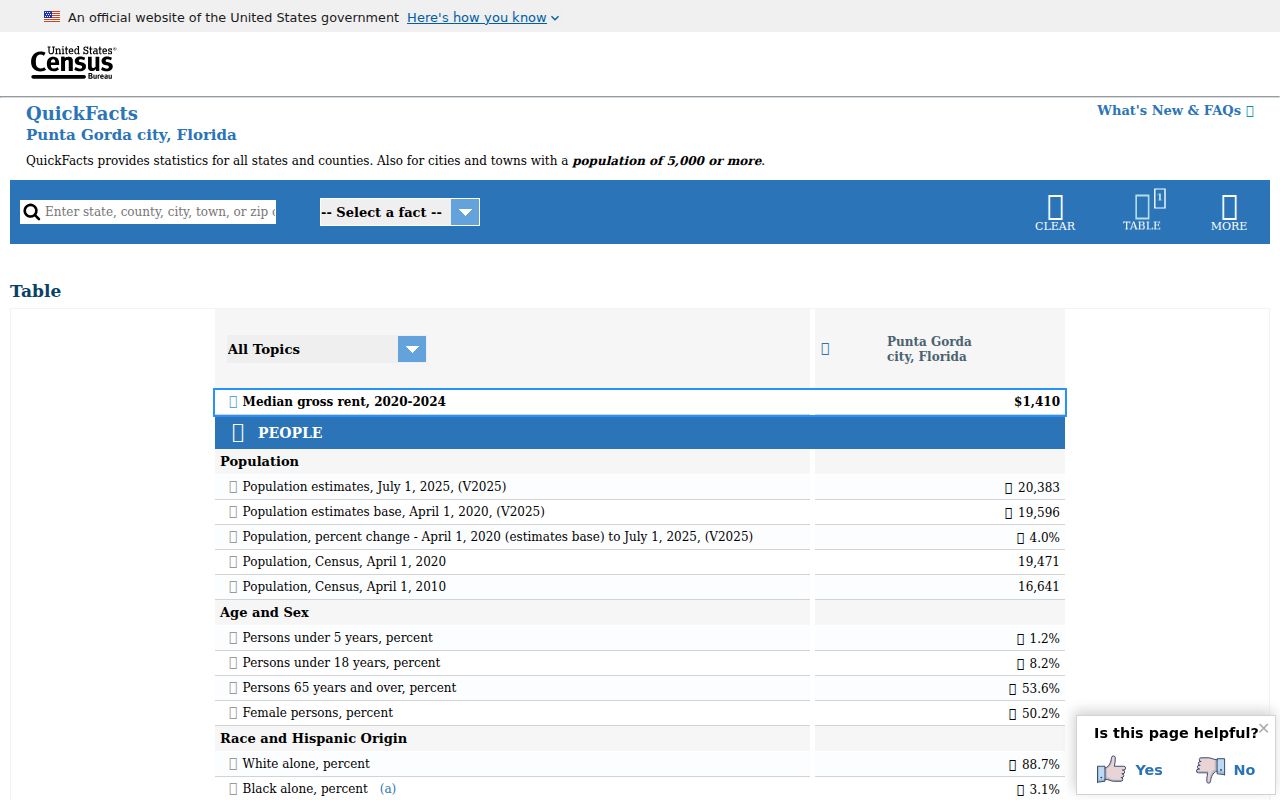
Those figures help explain why Punta Gorda has its own police records system while most Charlotte County communities rely on CCSO.
Port Charlotte and Englewood are not incorporated cities and do not have invented municipal police or court channels. Their local law-enforcement starting point is generally CCSO. Punta Gorda's city status is what makes PGPD the first stop for events inside its jurisdiction.
Punta Gorda Registry Monitoring
PGPD's Sexual Offender Monitoring Program has operated since April 2005. It checks FDLE data daily for new city registrants, verifies residence, reviews criminal history, case records, and supervision conditions, and checks nearby schools, day-care sites, and other at-risk locations. The city then handles notification and coordination with probation or parole.
Each registrant receives documented personal contact from an assigned officer at least monthly. The program is a notable local monitoring layer, not a replacement for the FDLE registry. Never reproduce private registrant details from a city or state display. For lawful county-wide search and status guidance, use the Charlotte County sex offender check.
Public Access Rules for Punta Gorda
Florida Public Records Law generally permits inspection and copying of nonexempt records held by PGPD, Charlotte County agencies, and the clerk. A requester usually does not need to explain a purpose. Agencies may review and redact exempt or confidential material before release. Juvenile information, active investigative details, victim-protected data, sealed records, and other statutory exemptions can limit what appears.
Key Statutes:
Chapter 119, Florida Statutes establishes Florida's public-record inspection framework and exemption process.
Florida Statutes §943.053 governs dissemination of criminal-history information by FDLE.
Florida Statutes §943.056 provides a fingerprint-based process for reviewing and challenging one's own Florida history.
Ask the custodian to identify the legal basis when material is withheld. No fixed statewide number of days controls an ordinary request. The agency must respond in good faith within a reasonable time after prompt acknowledgment. Specific, well-scoped requests are easier to process than broad demands for every record tied to a name.